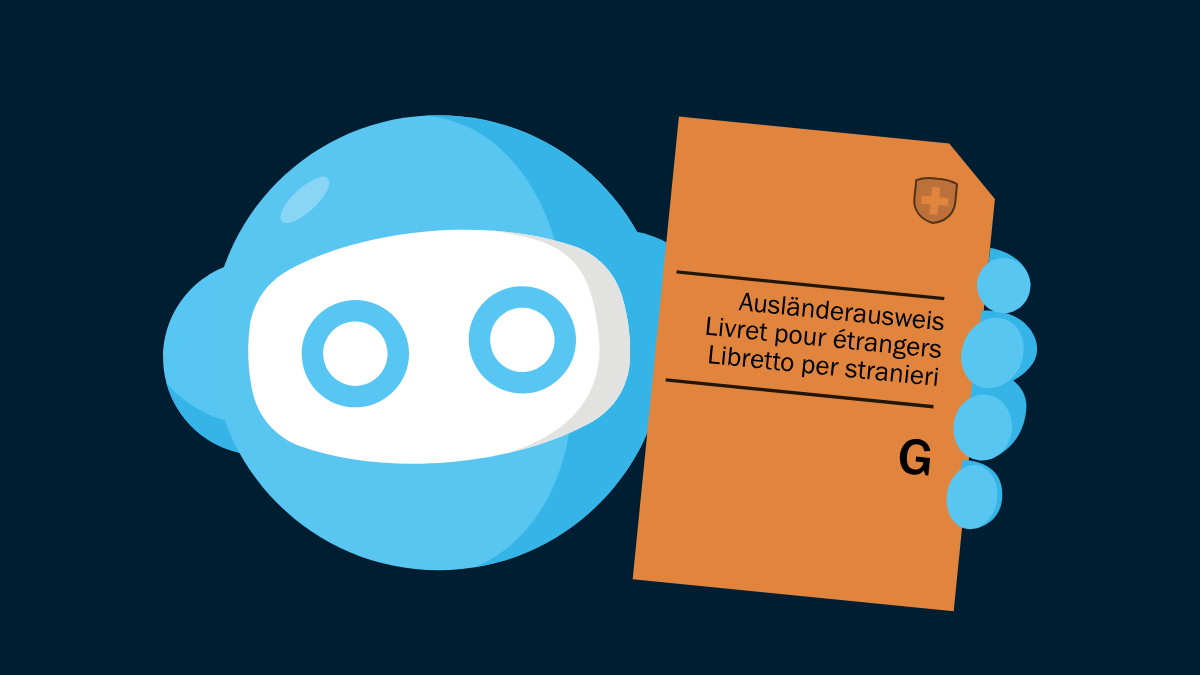
Swiss G Permit: The Complete Guide for Cross-Border Workers (2026 Edition)
Digitalization of procedures, new telework rules, and validity periods: discover everything you need to know to obtain and keep your cross-border work authorization.
 7 minutes read | Updated on
Author: Brice DELHOME
Landing a job in Switzerland is excellent news, but before you start your new position, one administrative step is mandatory: obtaining your work authorization. Switzerland strictly regulates its labor market and requires a legal document for any gainful activity carried out on its soil.
For the hundreds of thousands of professionals who reside in France, Germany, or Italy while working in Switzerland, the G Permit (Permis G / Grenzgängerbewilligung) acts as the key. Recently, the application procedures have been modernized with massive digitalization and new tax rules. Here is the completely updated guide for 2026 to understand your rights and obligations.
👉 For whom? Workers employed in Switzerland but domiciled abroad (mainly EU/EFTA zone).
👉 The key condition: You must return to your main residence abroad at least one day a week.
👉 Telework (New): The permanent agreement now allows you up to 40 percent telework without affecting your tax or social status.
👉 Format: The paper booklet is gone. The G permit is issued as a biometric plastic card (credit card format).
👉 The application (Digitalization): Applications must now be made online by your employer, via the federal portal Easy-Gov.swiss or dedicated cantonal portals.
In this guide:
- 🇨🇭 1. What is the G Permit compared to other permits?
- ⚖️ 2. Granting conditions and the new telework rule (40 percent)
- ⏱️ 3. Validity period and the 90-day rule
- 📝 4. Digitalized procedures and official links (Admin.ch)
- 🔄 5. Change of employer: What you need to know
- 💡 6. Ibani Champion: Repatriate your Swiss salary without abusive exchange fees
1. What is the G Permit compared to other permits?
Although it has signed the Agreement on the Free Movement of Persons (AFMP), Switzerland is not part of the European Union and manages its own migration policy. It uses a permit system to categorize workers:
| Permit Type | Who is it for? |
|---|---|
| G Permit (Cross-border) | For people who work in Switzerland but maintain their residence abroad. |
| B Permit (Residence) | For expats settling long-term (primary residence) in Switzerland. Valid for 5 years for Europeans. |
| L Permit (Short-term) | For temporary residents settling in Switzerland for a period of less than 1 year. |
| C Permit (Settlement) | The permanent permit, generally granted after 5 to 10 years of continuous residence in Switzerland. |
2. Granting conditions and the new telework rule
The granting of the G Permit for European citizens (EU-27/EFTA) is based on specific criteria defined by the AFMP:
- Nationality: Be a national of an EU/EFTA member state (For third countries, see the box below).
- Employment contract: Have a signed employment contract with a Swiss employer.
- The return rule: You must return to your home abroad at least one day a week. Many cross-border workers rent a room in Switzerland during the week ("semainiers"), which is legal as long as the weekly return is respected.
Since the final entry into force of the new agreements between Switzerland and its neighboring countries, cross-border workers can perform up to 40 percent of their working time remotely from their foreign home. This 40 percent threshold ensures that you keep your social status (affiliation to Switzerland) and that the taxation of your G Permit remains unchanged.
It is possible to obtain a G Permit, but the law is much more restrictive. You must have permanent residence rights in a border country and prove that you have lived there for at least 6 months. Additionally, your hiring is subject to the principle of "national preference" (the employer must prove that they found no Swiss or European candidate on the market).
3. Validity period and the 90-day rule
The validity of your G authorization depends on the nature of your contract:
- Open-ended contract (CDI) or fixed-term of more than a year: The G Permit is issued for a period of 5 years.
- Fixed-term contract of less than a year: The validity of the permit will match exactly the duration of your contract.
If you are hired for a contract of less than 3 months (maximum 90 working days per calendar year), the G Permit is not necessary. The Swiss employer must simply carry out an online "Notification procedure", no later than the day before your first day of work.
4. Digitalized procedures and official links
Since 2025, the digitalization of the Swiss administration has accelerated. The paper permit has disappeared in favor of a biometric credit-card-sized plastic card, and applications are made online.
Who handles the process?
It is the Swiss employer (via its federal portal Easy-Gov.swiss or cantonal desks) who is responsible for submitting the file before your first day of work. It is forbidden to start working without the authorization (or certificate of filing) having been issued.
Documents required to provide to your HR:
- Color copy of a valid ID.
- A passport-sized photo (for the plastic card).
- A copy of your signed employment contract.
- A recent proof of address in your country of residence.
👉 State Secretariat for Migration (SEM): Federal information on the G Permit
👉 Canton of Geneva (OCPM): Apply for a cross-border permit (Geneva)
👉 Canton of Vaud: Cross-border authorizations (Vaud)
5. Change of employer or canton
Thanks to bilateral agreements, European cross-border workers enjoy great professional mobility:
- Change of employer: You are free to change companies. Your G Permit remains valid until its expiration date. Your new employer will simply have to announce this change to the population service of the relevant canton, against an administrative fee (around 60-70 CHF).
- Self-employed status: Transitioning from employee to self-employed requires a new application to prove that the activity carried out in Switzerland is real, sustainable, and economically viable (Business Plan required).
6. Ibani Champion: Repatriate your Swiss salary without abusive exchange fees
Did your employer receive the validation of your G Permit? Congratulations! There is now one major logistical detail left for your purchasing power: how will you convert and repatriate your salary in Swiss Francs (CHF)?
As a new cross-border worker, you might open an account in a traditional Swiss bank for your local expenses. That's convenient, but using this same bank to convert and transfer your salary back home is a serious financial mistake. Banks apply a hidden exchange margin (often between 1.5 percent and 2 percent) on every international transfer. Over a full year, these invisible fees will cost you much more than the simple non-resident account maintenance fees (which are already high). It is almost equivalent to a lost thirteenth month!
🚀 The "Ibani Champion" solution:- A free Swiss IBAN: Open your ibani account from your smartphone. We instantly generate a dedicated Swiss IBAN (CH) for you, 100 percent free.
- The payment of your choice: Give this IBAN directly to your employer to receive your full salary, or simply make a domestic transfer from your Swiss bank account to your ibani account.
- Transparent and automatic exchange: Upon receipt of your Swiss francs, ibani converts them into euros at the real market rate and instantly transfers them to your main bank account back home. You bypass bank margins and maximize your purchasing power.
Simplify your cross-border finances
You have the G Permit, now get your Swiss IBAN to receive and convert your first salary in the best conditions.
Get my free Swiss IBANFrequently Asked Questions (G Permit)
How long is the G Permit valid?
The G Permit is valid for 5 years if you have an open-ended contract (permanent) or a fixed-term contract of more than one year. If your contract is for less than one year, the validity will exactly match your contract's duration.
Can I work from home in my country with a G Permit?
Yes. In 2026, the permanent agreement between Switzerland and its neighboring countries allows cross-border workers to spend up to 40 percent of their working time teleworking (including temporary missions), without losing their tax status or changing their Swiss social security affiliation.
Who applies for the G Permit on the Easy-Gov portal?
In the overwhelming majority of cases, it is your Swiss employer who must submit the cross-border authorization request for you via the Confederation's online desk (Easy-Gov.swiss) or the cantonal portal, before you start working.
Master your cross-border life
Do not miss any of our legal, tax, and financial guides to optimize your professional journey in Switzerland.
Subscribe to the ibani newsletter