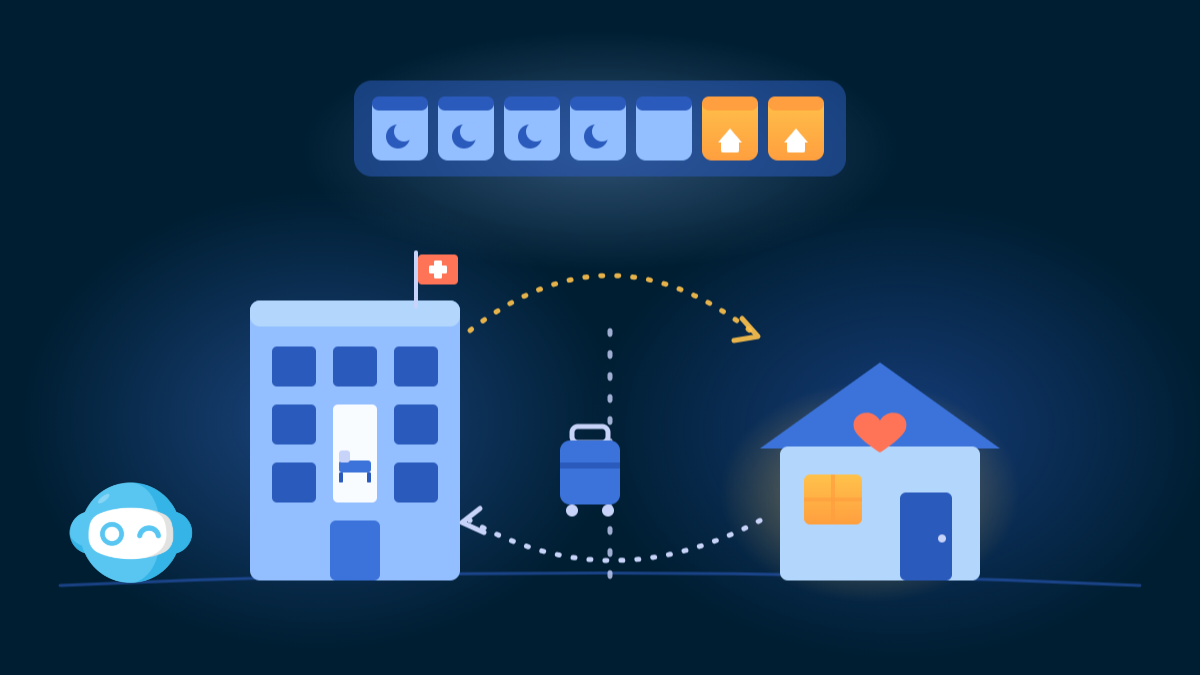
Weekly commuter: you stay in Switzerland during the week and go home at weekends. Which status, which tax, which insurance?
 Reading time: 15 minutes | Updated:
- G permit, AVS, health insurance: you remain a cross-border worker if you return home at least once a week (ALCP, Annex I, Art. 7; Regulation (EC) No 883/2004, Art. 1(f)). The only new obligation: registering with the municipality where you stay during the week.
- Resident of France: in the eight cantons of the 1983 agreement (including Vaud, Neuchâtel, Jura, Valais, Basel and Bern), staying in Switzerland during the week moves your salary from French tax to Swiss withholding tax. In Geneva and the other cantons, you were already taxed at source.
- Resident of Germany: beyond 60 non-return days a year for work-related reasons, you are no longer a cross-border worker for tax purposes. Since 2026, a journey of more than 100 km or of more than 1.5 hours by public transport makes returning home unreasonable.
- Resident of Italy: beyond 45 non-return days, you lose the status under the 2020 agreement for the year: standard Swiss rate scale, taxation in Italy with a tax credit, without the EUR 10,000 allowance.
- In Switzerland: taxed at source at the standard rate scale, on your working days in Switzerland and, if you are a resident in France, on your telework days up to 40% of your working time. With at least 90% of your income in Switzerland, a subsequent ordinary assessment allows you to deduct your living costs away from home (rent for a room, CHF 30 a day for meals for direct federal tax).
Contents of this guide:
- 🧭 1. Why are you a cross-border worker for some purposes and not for others?
- 🪪 2. Does your G permit remain valid?
- 🇫🇷 3. Resident of France: what changes depending on your canton
- 🇩🇪 4. Resident of Germany: the 60-day and 100 km rule
- 🇮🇹 5. Resident of Italy: the rientro settimanale outside the agreement
- 🧾 6. How does Switzerland tax you?
- 🛏️ 7. Accommodation, meals, travel: what you can deduct
- 🏡 8. Your family stays at home: where are you tax resident?
- 🩺 9. Social security and health insurance: what does not change
- 🔁 10. Should you apply for an L or B permit instead?
- ✅ 11. What should you remember?
- ❓ 12. Frequently asked questions
You work in Switzerland, your family lives in France, Germany or Italy, and the daily commute has become too long. You rent a room or a studio near your work, you sleep there from Monday to Thursday and you go home on Friday evening. Your G permit allows this. Your tax status, however, is no longer necessarily that of a cross-border worker.
This guide explains what this way of life changes, country by country: the permit, tax in Switzerland and in your country of residence, the costs you can deduct, social security and health insurance. It is aimed at nationals of the European Union or EFTA who reside in France, Germany or Italy and work as employees in Switzerland. If you go home every evening and only spend a few nights a year away from home, our guide on non-return days for cross-border workers covers your situation.
1. Why are you a cross-border worker for some purposes and not for others?
Because immigration law and social security are satisfied with a weekly return, whereas the tax agreements in principle require a daily return. The Agreement on the Free Movement of Persons defines a cross-border worker as a person employed in the other State who returns to their home in principle every day, or at least once a week (ALCP, Annex I, Art. 7(1)). The social security coordination regulation uses the same definition (Regulation (EC) No 883/2004, Art. 1(f)).
The tax agreements follow a different logic. The 1983 Franco-Swiss agreement covers a person who, as a general rule, returns each day to their State of residence. The 2020 Italian-Swiss agreement requires a return “in linea di principio, quotidianamente”. The German-Swiss convention refers to a regular return, but removes the status beyond 60 non-return days for work-related reasons. Each tolerates a limited number of nights away from home, and a weekly commuter in principle exceeds them by a wide margin (with a nuance for Germany, section 4).
The tax authorities say so themselves: the tax definition of a cross-border worker differs from that of the permit issued by the cantonal migration offices (joint FAQ of the Swiss Federal Tax Administration and the cantons of Graubünden, Ticino and Valais, question 2.1).
| You stay in Switzerland from Monday to Thursday | Resident of France | Resident of Germany | Resident of Italy |
|---|---|---|---|
| G permit | Kept | Kept | Kept |
| AVS, AI, unemployment insurance | In Switzerland, unchanged | In Switzerland, unchanged | In Switzerland, unchanged |
| Right of option for health insurance | Maintained | Maintained | Maintained |
| Cross-border worker tax status | Lost in the eight cantons of the 1983 agreement; not relevant in Geneva and the other cantons | Lost if more than 60 non-return days for work-related reasons | Lost for the year beyond 45 non-return days |
| Swiss tax | Withholding tax, standard rate scale | If status lost: withholding tax, standard rate scale instead of 4.5% | Withholding tax, standard rate scale, without the 80% cap |
| Tax in your country | Salary declared, tax credit equal to the French tax | If status lost: salary exempt, taken into account for the rate | Salary taxed, credit for the Swiss tax, without the EUR 10,000 allowance |
2. Does your G permit remain valid?
Yes, as long as you return to your home abroad at least once a week. Border zones have been abolished for nationals of the European Union and EFTA: you can work and stay in any canton with a G permit, provided you keep your main home abroad and return there every week (State Secretariat for Migration, G EU/EFTA permit).
One formality is added: cross-border workers who stay in Switzerland during the week are required to register with the competent authority of their place of residence (Ordinance on the Introduction of the Free Movement of Persons (OLCP), Art. 9(4)). In practice, you report to the residents' registration office of the municipality where you stay. This registration does not make you a Swiss resident: it records where you stay during the week.
For the rest, the rules of the G permit apply as they do for a cross-border worker who goes home every evening, including reporting any change of employer before starting the new job (OLCP, Art. 9(3)).
3. Resident of France: what changes depending on your canton
Everything depends on your canton of employment. In the eight cantons of the agreement of 11 April 1983 (Bern, Solothurn, Basel-Stadt, Basel-Landschaft, Vaud, Valais, Neuchâtel and Jura), a cross-border worker's salary is taxed in France, and Switzerland does not withhold tax at source if the worker gives their employer the certificate of residence stamped by the French tax authorities. This regime is reserved for a person who, as a general rule, returns to France each day (agreement of 11 April 1983, Art. 3).
French tax doctrine allows exceptions: 45 nights a year outside France, including business trips to a third country, but no more than one night per working week (BOFiP, BOI-INT-CVB-CHE-10-20-60, § 70). It adds that renting accommodation in the State of employment, or having exclusive use of it, in principle constitutes a rebuttable presumption that the employee is not a cross-border worker. The tax administration sums up the consequence: if the worker resides in the canton during the week or stays in Switzerland for more than 45 nights a year, their income is taxed at source in Switzerland (impots.gouv.fr, page Suis-je bien un travailleur frontalier ?).
The weekly commuter then falls under the general rule of the Franco-Swiss convention: the salary is taxable in the State where the employment is exercised (convention of 9 September 1966, Art. 17(1)). Your employer withholds tax at source, and you no longer have a 2041-AS certificate to provide: that document serves precisely to avoid this deduction (see our guide on the 2041-AS certificate).
In Geneva and the other cantons (Zurich, Fribourg, Aargau, etc.), the essentials do not change: you were already taxed at source in Switzerland as a daily cross-border worker. Two reservations: the tax goes to the canton where you stay during the week, if it differs from your canton of employment, and a single person may be presumed to have moved the centre of their life to Switzerland (section 6). The agreement of 29 January 1973 only governs the financial compensation that Geneva pays to the French local authorities for their residents who work in Geneva (rsGE D 1 45).
Your tax return in France. As a resident of France, you declare your Swiss salary every year. The 2047-SUISSE notice addresses your case explicitly: if you return to France only at weekends, you fall within the case of employees taxed by Switzerland, like Geneva cross-border workers (2047-SUISSE notice). The salary is entered on return 2047 and on the 2042, lines 1AF to 1DF and box 8TK. France grants you a tax credit equal to the French tax corresponding to that salary, provided it has been subject to Swiss tax (convention, Art. 25 A(1)(a)). According to the doctrine, this method results in the exemption of foreign-source income (BOI-INT-DG-20-20-100, § 43): your Swiss salary is not taxed a second time, but it is included in calculating the rate applied to your household's other income, for example your spouse's French salary.
Example: Claire, resident of Pontarlier, employed in Lausanne. Claire used to commute every day and gave her 2041-AS certificate to her employer in Vaud: her salary was taxed in France. She now rents a room in Lausanne, where she sleeps from Monday to Thursday. She leaves the 1983 agreement: her employer withholds Vaud tax at source at the standard rate scale. In France, she continues to declare her salary, which gives entitlement to a tax credit equal to the French tax. If her Swiss salary represents at least 90% of her couple's worldwide gross income, she can request a subsequent ordinary assessment in Switzerland to deduct her living costs away from home (section 7).
4. Resident of Germany: the 60-day and 100 km rule
You lose cross-border worker status if, on more than 60 working days a year, you do not return home because of your work, for employment exercised throughout the calendar year (German-Swiss convention, Art. 15a(2)). A cross-border worker who keeps this status bears a Swiss deduction of at most 4.5% and remains taxed in Germany, which credits this deduction.
Not all nights spent in Switzerland count. Since the 2026 tax period, the rules have been set out in the protocol to the convention, amended on 21 August 2023 (AS 2025 791), which replaces the 1991 negotiation protocol. A person is deemed not to return home because of their work if returning is not possible or not reasonable for work-related reasons. By car, returning is, in particular, not reasonable when the one-way journey by the shortest route exceeds 100 km; by public transport, when it takes more than 1.5 hours at usual commuting times. The mode of transport mainly used is decisive, and only the nights on which you actually did not go home count.
Below these thresholds, the assessment is made case by case. The Bundesfinanzhof held, for a journey of 90 to 97 km, that working days of around ten hours with a restart at 6 a.m. the next day made returning home unreasonable, and that no distance criterion is sufficient on its own (BFH, 9 April 2026, VI R 31/24). It also points out that the burden of proving non-return days lies with you and that they cannot be estimated. If you sleep in Switzerland merely for convenience, when returning home would be reasonable, those nights do not count towards the 60 days. That is not always enough to remain a cross-border worker: since 2026, the protocol also requires a regular return, meaning a round trip between home and the workplace on at least 20% of the agreed working days (protocol, point 5(b)). It does not specify how to count an outward journey on Monday and a return on Thursday: have your status confirmed by the tax administration of your canton before relying on the 4.5% deduction.
A weekly commuter who exceeds the 60 days has their employer certify their non-return days on the official Gre-3 form, submitted to the cantonal tax administration (FTA, circular no. 45, point 4.6). They are then taxed at source in Switzerland at the standard rate scales (A, B, C, E or H) instead of the scales capped at 4.5% (L, M, N and P). In Germany, the salary for work performed in Switzerland is exempt, but taken into account for the rate applied to your other income (convention, Art. 24(1), no. 1(c), and no. 2; § 32b EStG). You must still file a tax return in Germany, with Anlage N and Anlage N-AUS. The days you telework from Germany remain taxable in Germany.
5. Resident of Italy: the rientro settimanale outside the agreement
The Italian-Swiss agreement of 23 December 2020 no longer treats you as a cross-border worker for the year in which you exceed 45 non-return days. To be a cross-border worker within the meaning of this agreement, you must at the same time reside in a municipality located wholly or partly within the 20 km zone of the border, work in the canton of Graubünden, Ticino or Valais, and return “in linea di principio, quotidianamente” to your main home (agreement of 23 December 2020, SR 0.642.045.43, Art. 2(b)). The additional protocol tolerates at most 45 non-return days per calendar year for work-related reasons, holidays and illness not counted. The official FAQ of the tax administrations specifies that a person who exceeds this cap loses cross-border worker status for the year in question (question 2.7). If you work in Zurich or Bern, the agreement does not apply in any case, whatever your rhythm of return.
In Switzerland, you are then taxed at the standard rate scales of withholding tax. Scales R to V, which cap the tax at 80% of the ordinary tax, are reserved for cross-border workers under the agreement (Withholding Tax Ordinance (OIS), Art. 1). In Italy, your salary is taxed under the 1976 convention (Art. 15 and 24), with a credit for the tax paid in Switzerland (Art. 165 TUIR).
The EUR 10,000 allowance is not available to you. It covers employees resident in Italy who work abroad in a border area, and the Agenzia delle Entrate requires them to travel there “quotidianamente, ossia in tutti i giorni lavorativi” (circular no. 25/E of 18 August 2023). The rientro settimanale rules it out.
If you are an “old” cross-border worker (vecchi frontalieri), that is, if you were already working in the Swiss border area between 31 December 2018 and 17 July 2023, your salary is in principle taxable only in Switzerland (agreement, Art. 9). A year of rientro settimanale makes you lose this status for that year: your salary is then also taxed in Italy, with a tax credit. The texts do not expressly specify what happens to the transitional regime in the following years; ask the tax administration of your canton of employment (Ticino, Graubünden or Valais) before changing your rhythm.
6. How does Switzerland tax you?
Through tax withheld at source, at the standard rate scales of the canton where you stay during the week, usually that of your work, on the salary for your working days in Switzerland. The competent canton is the one where you stay during the week (LIFD, Art. 107(2)). A worker resident abroad, whether a cross-border worker or a worker who stays in Switzerland on a weekly or short-term basis, is taxed at source on the salary paid by a Swiss employer (Federal Act on Direct Federal Taxation (LIFD), Art. 91(1); FTA, circular no. 45, point 3.1.2). The scale depends on your family situation, even if your family lives abroad: the circular gives the example of a worker domiciled abroad, who stays in Switzerland during the week, whose spouse is not gainfully employed and who has two minor children, to whom scale B2 applies.
Days worked outside Switzerland are excluded from taxable salary, but not from the calculation of the rate. The circular gives the example of a weekly commuter paid CHF 8,000 for a month of 20 working days, 5 of them in Austria: CHF 6,000 is taxed, at the rate corresponding to CHF 8,000. Telework from your country of residence follows the rules of each convention. If you are a resident in France, your telework days remain taxable in Switzerland up to 40% of your working time per calendar year (Franco-Swiss convention, Art. 17(5), and additional protocol; LIFD, Art. 91(2)). If you reside in Germany or Italy without cross-border worker status, they are in principle taxable in your country and excluded from the salary taxed in Switzerland. The 25% telework cap provided for by the Italian-Swiss agreement only applies to cross-border workers under that agreement.
One reservation: according to case law and doctrine, a single person who stays in Switzerland during the week is presumed to have established the centre of their life there, as the tax manual of the canton of St. Gallen points out (Steuerbuch St. Gallen, StB 105 Nr. 2). This presumption falls if you prove that your ties remain in your country; failing that, you are taxed as a Swiss resident, on all your income, subject to the convention. For a married person whose family stays abroad, the same manual presumes, on the contrary, that the domicile remains abroad.
7. Accommodation, meals, travel: what you can deduct
Your living costs away from home are deductible, but not through withholding tax: you need a subsequent ordinary assessment. A taxpayer who stays at their place of work on working days and regularly returns home on days off can deduct the additional expenses linked to this stay (FDF Ordinance on Professional Expenses, Art. 9). For direct federal tax, this includes:
- the rent for a room, at the usual rents of the place of stay;
- a flat rate of CHF 30 a day for meals, i.e. at most CHF 6,400 a year (CHF 22.50 a day and CHF 4,800 a year when one of the two main meals only gives entitlement to a half deduction, for example thanks to a company canteen);
- the costs of regularly returning home and of travelling between the accommodation and work, up to CHF 3,300 a year (LIFD, Art. 26(1)(a)).
The cantons set their own amounts for cantonal and municipal tax. If your employer reimburses these living costs, the allowance forms part of the gross salary subject to withholding tax (FTA, circular no. 45, point 3.2.4), and you cannot deduct a second time what the employer has reimbursed.
A person domiciled abroad obtains this assessment if they declare at least 90% of their worldwide gross income in Switzerland, including that of their spouse (quasi-residence). They must file a written request by 31 March of the following year at the latest, and can no longer withdraw it (OIS, Art. 14). The law also allows the request if your situation is comparable to that of a taxpayer domiciled in Switzerland (LIFD, Art. 99a(1)(b)). A spouse who works in your country of residence often takes the couple below 90%. Our guide on quasi-resident status details the calculation.
Order of magnitude, for direct federal tax. Claire stays in Lausanne 4 nights a week for 46 weeks; let us count 184 days of stay. Her room costs her CHF 700 a month. Her deductions for staying away from home amount to 184 × CHF 30 = CHF 5,520 for meals, CHF 8,400 for rent and at most CHF 3,300 for her travel, i.e. at most CHF 17,220. This calculation applies to direct federal tax; the canton of Vaud applies its own rules for cantonal and municipal tax. The ordinary assessment is only worthwhile if these deductions exceed the effect of the flat-rate deductions already included in the scale: have both simulated before filing an irrevocable request.
8. Your family stays at home: where are you tax resident?
In principle in the country where your family lives. Under French law, the family residence remains your home even if, because of the needs of your profession, you stay elsewhere for most of the year, provided your family continues to live there and all its members come together there (BOI-IR-CHAMP-10, § 110). The Franco-Swiss convention resolves dual residence in favour of the State where the centre of vital interests lies, that is, the place with which your personal relations are closest (Art. 4(2)(a)). The Bundesfinanzhof applied the same reasoning to a weekly commuter resident in Germany who lived with his family in Germany.
On the Swiss side, you are in principle treated as a person domiciled abroad (LIFD, Art. 91). If Switzerland also considered you a resident, for example on the basis of a stay of at least 30 days with gainful employment (LIFD, Art. 3(3)), the convention would decide: if it allocates your residence to the other State, Switzerland taxes you under the rules of limited tax liability, on your Swiss income only (FTA, circular no. 45, point 2.3). Keep evidence of your family life abroad (lease or ownership, children's schooling, spouse's employment), and your weekend travel tickets.
9. Social security and health insurance: what does not change
Your social security status does not depend on your tax status. You return to your State of residence at least once a week: you remain a cross-border worker within the meaning of Regulation (EC) No 883/2004. You continue to pay contributions in Switzerland to the AVS, the AI, the APG and unemployment insurance, since you work there.
Your right of option for health insurance is maintained, as long as your residence within the meaning of coordination remains in your country; a single person may have to demonstrate this. The Common Institution under the Health Insurance Act (KVG/LAMal) points out that the definition of a cross-border worker in coordination does not depend on the permit, but only on the exercise of gainful employment and on returning to the State of residence, as a general rule every day, but at least once a week (Common Institution KVG/LAMal, guide to health insurance in connection with the EU and EFTA, 2023 edition). The choice made at the start of your employment, LAMal or the insurance of your country, remains irrevocable and stays with you. Our guide to changing health insurance explains the rare cases in which it can be reviewed.
In the event of full unemployment, it is in principle your country of residence that pays your benefits, as for any cross-border worker (Regulation (EC) No 883/2004, Art. 65(2)). Our guide on unemployment for cross-border workers details the calculation.
10. Should you apply for an L or B permit instead?
Not if your family and your home remain in your country. A short-term L permit or a B residence permit valid for at least three months in principle makes you subject to compulsory LAMal health insurance (Health Insurance Ordinance (OAMal), Art. 1(2)(f)). The exception on request, the right of option, covers persons who reside in a European Union State (Art. 2(6)). The Common Institution KVG/LAMal accepts that a B permit holder who returns to their family every week may remain a cross-border worker for coordination purposes, but in that case it provides for an in-depth examination of the situation.
For tax purposes, a B permit does not on its own make you a resident, but it makes it harder to show that the centre of your life has remained abroad. The G permit matches your situation exactly: main home abroad, return every week.
11. What should you remember?
- Staying in Switzerland during the week calls into question neither your G permit, nor your Swiss contributions, nor your right of option for health insurance. Register with the municipality where you stay.
- For tax purposes, a weekly commuter is in principle no longer a cross-border worker. As a resident of France in one of the eight cantons of the 1983 agreement, you move to Swiss withholding tax. As a resident of Germany beyond 60 non-return days, or of Italy beyond 45 days, you lose the cross-border regime.
- Switzerland taxes you at the standard rate scale, on your working days in Switzerland and, if you are a resident in France, on your telework days up to 40%. Your country of residence avoids double taxation, through a tax credit (France, Italy) or an exemption that counts for the rate (Germany).
- Your living costs away from home are only deductible in a subsequent ordinary assessment, available if you earn at least 90% of your income in Switzerland. Request it by 31 March at the latest, after a simulation.
- Keep evidence of your weekly return and of your family life abroad: this evidence underpins your permit, your tax residence and your right of option alike.
12. Frequently asked questions
Official sources
- Free movement and social security: Agreement on the Free Movement of Persons (ALCP, SR 0.142.112.681) (in French), Annex I, Art. 7; Ordinance on the Introduction of the Free Movement of Persons (OLCP, SR 142.203) (in French), Art. 9; Regulation (EC) No 883/2004 (SR 0.831.109.268.1) (in French), Art. 1(f) and 65; State Secretariat for Migration (SEM), G EU/EFTA permit — accessed 23 November 2026
- Swiss tax: Federal Act on Direct Federal Taxation (LIFD, SR 642.11) (in French), Art. 3, 26, 83, 91, 99a and 107; Withholding Tax Ordinance (OIS, SR 642.118.2) (in French), Art. 1 and 14; FDF Ordinance on Professional Expenses (SR 642.118.1) (in French), Art. 5 and 9 and appendix, as at 1 January 2026; Swiss Federal Tax Administration (FTA), circular no. 45 of 12 June 2019 on withholding tax (in French), points 2.3, 3.1.2, 3.2.4, 4.6 and 7.5; canton of St. Gallen, Steuerbuch StB 105 Nr. 2 and StB 105 Nr. 3 (in German)
- France (in French): agreement of 11 April 1983 on cross-border workers; Franco-Swiss convention of 9 September 1966, consolidated version, Art. 4, 17 (including paragraph 5 and the additional protocol on telework) and 25 A; BOFiP BOI-INT-CVB-CHE-10-20-60, BOI-INT-DG-20-20-100 and BOI-IR-CHAMP-10; impots.gouv.fr, cross-border worker; 2047-SUISSE notice; agreement of 29 January 1973 on financial compensation (rsGE D 1 45) — accessed 23 November 2026
- Germany: German-Swiss double taxation convention (SR 0.672.913.62) (in French), Art. 4, 15, 15a and 24, and protocol, point 5, as amended by the protocol of 21 August 2023 (AS 2025 791); Bundesfinanzhof, judgment of 9 April 2026, VI R 31/24 (in German); § 32b EStG (in German)
- Italy: agreement of 23 December 2020 on the taxation of cross-border workers (SR 0.642.045.43) (in French), Art. 2, 3 and 9, and additional protocol; FAQ of the FTA and the cantons of Graubünden, Ticino and Valais, questions 2.1 and 2.7 (in Italian); Agenzia delle Entrate, circular no. 25/E of 18 August 2023 (in Italian)
- Health insurance: Health Insurance Ordinance (OAMal, SR 832.102) (in French), Art. 1 and 2; Common Institution KVG/LAMal, guide to health insurance in connection with the EU and EFTA, 2023 edition (in German)
A salary in francs, bills in euros?
Our Geneva-based team supports cross-border workers who receive income in Swiss francs and have to settle their bills in euros. A financial intermediary audited for its activity, affiliated with SO-FIT (SRO).
We are available by email or by phone from Monday to Friday.
Back to guidesGet our next guide by email
Don't miss our next article on life and work in Switzerland, and receive it straight into your mailbox when published!
Subscribe