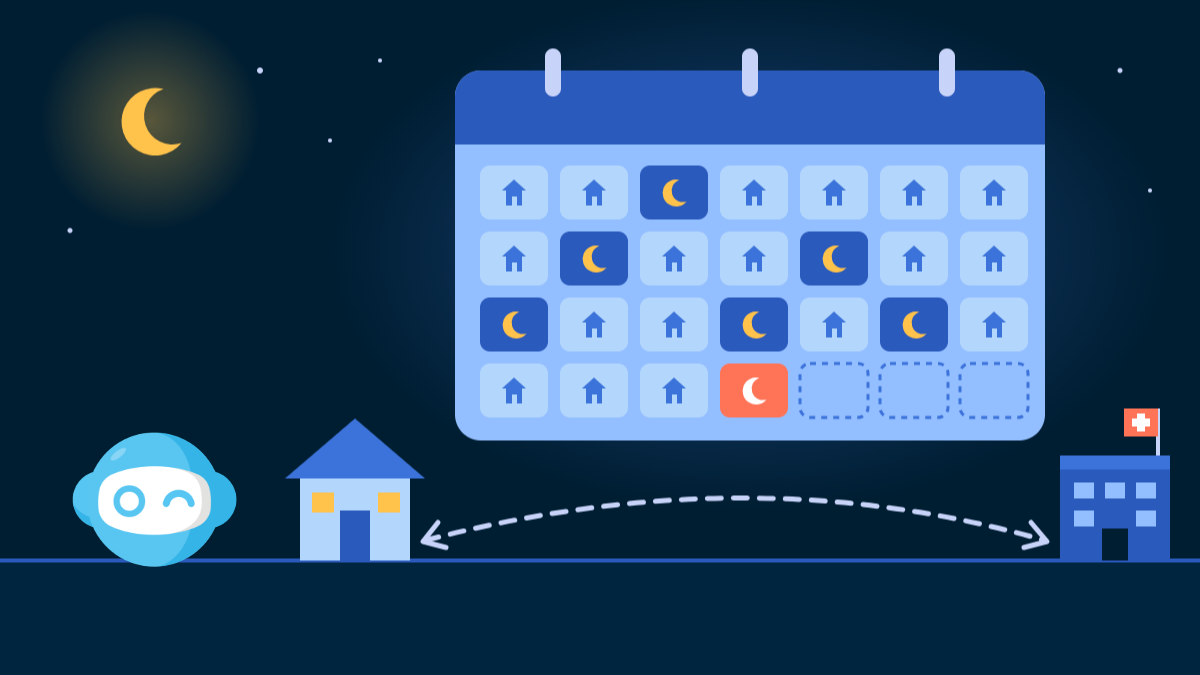
Non-return days: how many nights can a cross-border worker spend away from home without losing their tax status?
 Reading time: 13 minutes | Updated:
- Resident of France, employed in one of the eight cantons of the 1983 agreement: 45 nights a year outside France, no more than one per working week, trips to a third country included. In Geneva, the rule does not apply: tax is deducted at source there in any case.
- Resident of Germany: 60 non-return days (Nichtrückkehrtage) for work-related reasons per calendar year, i.e. five a month for full-time work. Every working day in a third country counts, even without an overnight stay.
- Resident of an Italian municipality in the 20 km zone, employed in Ticino, Graubünden or Valais: 45 days per calendar year, roughly one a week.
- Not counted: telework days, which have their own caps (40% for a resident of France, 25% for a resident of Italy), nor, for a resident of Germany or Italy, private absences such as holidays. For a resident of Germany, illness and accidents do not count either.
- One day too many changes the tax treatment of the whole year, not just of the excess day: twelve months of salary switch tax regime.
Contents of this guide:
- 🧭 1. Why can a night away from home change your tax?
- 🇫🇷 2. Resident of France: how does the 45-night tolerance work?
- 🇩🇪 3. Resident of Germany: how are the 60 days counted?
- 🇮🇹 4. Resident of Italy: what does the new agreement provide?
- 📋 5. What counts, and what does not?
- ⚠️ 6. What happens when you exceed the cap?
- 🗓️ 7. How do you keep your tally, and which documents must you provide?
- 💱 8. A salary in francs, bills in euros: what does losing the status change?
- ❓ 9. Frequently asked questions
For the tax authorities, a cross-border worker is first and foremost someone who goes home to sleep. The three agreements that govern the taxation of cross-border workers with Switzerland, the one concluded with France, the convention with Germany and the new agreement with Italy, all rest on this daily return, and all tolerate a certain number of exceptions a year. A three-day training course in Zurich, a week at a trade fair in Milan, night shifts at the hospital: every night spent elsewhere goes into a counter that the employee has every interest in keeping themselves, and that the administration can reconstruct after the fact. This guide gives the caps for each country of residence, how to count them and what happens when you go over them.
1. Why can a night away from home change your tax?
Because the cross-border worker's tax regime is an exception, and an exception comes with conditions. The general rule of double taxation conventions is that a salary is taxed where the work is performed. The cross-border agreements depart from this allocation: taxation in the state of residence only for a resident of France, a Swiss deduction capped at 4.5% for a resident of Germany, exclusive or reduced taxation in Switzerland for a resident of Italy. This exception has a counterpart: a daily link with the home. When that link loosens, the exception ends and the general rule applies again.
Cross-border worker status for tax purposes is not the same thing as the G permit. The permit is an authorisation for cross-border commuters issued by the cantonal migration office; tax status is determined by other criteria. The Vaud tax administration puts it plainly: merely holding a G permit is not relevant, for tax purposes, in deciding whether a person meets the conditions for the status. The Bern and federal tax administrations say the same for residents of Germany and Italy. Our guide to the G work permit in Switzerland deals with the cross-border commuter permit; this one deals with tax.
| Country of residence | Applicable text | Where it applies | Annual non-return cap | Telework cap |
|---|---|---|---|---|
| France | Agreement of 11 April 1983, exchange of letters of 2005 | Bern, Solothurn, Basel-Stadt, Basel-Landschaft, Vaud, Valais, Neuchâtel, Jura | 45 nights, at most one per working week | 40% of working time, including at most 10 days of assignments |
| Germany | Convention of 11 August 1971, art. 15a | All of Switzerland | 60 working days | No quota; journey on at least 20% of agreed days |
| Italy | Agreement of 23 December 2020, applied since 2024 | Graubünden, Ticino, Valais, for a home in a municipality on the official 20 km list | 45 days | 25% of working time |
These caps apply to full-time employment over the whole calendar year. For residents of France and Germany, part-time work and employment that starts or ends during the year reduce them, under rules detailed below. For residents of Italy, no reduction rule has been published.
2. Resident of France: how does the 45-night tolerance work?
It only concerns cross-border workers employed in one of the eight cantons that signed the agreement of 11 April 1983: Bern, Solothurn, Basel-Stadt, Basel-Landschaft, Vaud, Valais, Neuchâtel and Jura. In these cantons, a cross-border worker who meets the conditions is not taxed in Switzerland; they pay income tax in France, and in return Switzerland receives financial compensation of 4.5% of the gross payroll. For a resident of France employed in Geneva, Zurich or Aargau, the question of nights does not arise in the same terms: their salary is taxed at source in Switzerland from day one. Our guide to cross-border worker taxes sets out this split by canton.
The principle: returning every day, as a general rule
The agreement defines a cross-border worker as any resident of one state who is employed in the other state by an employer established in that other state and who, as a general rule, returns each day to the state of which they are a resident. The exchange of letters of 21 and 24 February 2005 between the Swiss and French authorities put a figure on this “general rule”: 45 nights a year spent outside the state of residence are allowed without calling cross-border worker status into question.
The BOFiP, France's official public finance bulletin, sets out the spirit of the rule. Nights spent in the state of employment must remain exceptional and must not exceed one night per working week. The 45-day cap includes occasional business trips to a third country. It is reduced to 20% of working days for an activity carried out over only part of the year, and reduced proportionally for part-time work.
The Vaud tax administration, for its part, applies a practical benchmark: a return home at least four days a week for a 100% activity rate. It reserves the right to check actual returns where the distance between the workplace and the home appears too great.
Telework and assignments: two counters that overlap
Since 1 January 2023, an amicable agreement has allowed a cross-border worker to telework from France for up to 40% of their annual working time without losing their status. This quota includes a tolerance of ten days a year of temporary assignments carried out for the employer in France or in a third country. A second agreement, dated 30 June 2023, governs how these three limits fit together: the 40%, the ten days and the 45 nights.
- Ordinary telework days are charged first to the 40% quota, then temporary assignments, starting with those carried out in France.
- An assignment in France that no longer fits within the ten days or the 40% causes the status to be lost, even if it is only one day over.
- An assignment in a third country that no longer fits moves into the 45-day cap set in 2005. It only causes the status to be lost if that cap is itself exceeded.
- The ten days are reduced proportionally, and rounded up to the next whole day, for part-time work or an activity lasting less than the calendar year.
- On-call periods are not temporary assignments. They only count as telework if they involve an actual intervention from France.
3. Resident of Germany: how are the 60 days counted?
Article 15a of the German-Swiss convention caps the Swiss deduction at 4.5% of gross salary for a cross-border worker, with Germany taxing the salary and crediting this deduction against its own tax. The rule applies in all cantons. The status is lost when the employee cannot return home, for work-related reasons, on more than 60 working days per calendar year. The Bern tax administration turns the cap into a simple benchmark: five days a month for full-time work.
What a non-return day is
A working day scheduled under the contract on which returning home is not possible or not reasonable for a work-related reason. The Bern tax administration cites trips lasting several days, on-call and standby duty, and any other reason that keeps the employee at their place of work. A German-Swiss consultation agreement of 12 October 2018 set out what an unreasonable return is: more than 100 kilometres by the shortest road route by car, or more than 90 minutes by the fastest public transport connection, at usual commuting times, one way.
- Working days in a third country always count, whether or not the employee goes home to sleep. A same-day return trip to Paris or Vienna is a non-return day.
- A one-day trip within Switzerland or Germany does not count.
- Saturdays, Sundays and public holidays only count if the employer has expressly instructed work on those days, in return for compensatory time off or extra pay. On a trip lasting several days whose costs the employer pays, the federal tax administration, by contrast, counts all weekends and public holidays.
- Holidays, illness and accidents do not count, nor do nights spent elsewhere for private reasons.
- Telework days do not count as non-return days.
- Night or shift work does not, on its own, make a non-return day: a schedule straddling two calendar days remains compatible with the status, provided the employee returns home at the end of the shift.
Telework: no quota, but a minimum of journeys
For a resident of Germany, the status depends not on a telework quota but on a regular return. The Bern tax administration defines it as follows: the employee must travel from home to the workplace and back on at least 20% of the agreed working days in the calendar year. An employee who only travelled to Switzerland once a month would no longer meet this condition, even without a single night spent there.
Part-time work, incomplete year, several employers
| Situation | Non-return cap |
|---|---|
| Full-time, whole year | 60 days |
| Part-time worked a few hours every working day | 60 days |
| Part-time in full days | 60 days reduced in proportion to the days worked (basis of 250 days for a five-day week) |
| Example: two days a week, five-day company | 60 × 2 × 52 ÷ 250, i.e. 25 days |
| Hire or departure during the year | 5 days per full month and 1 day per full week of employment |
| Several employers in Switzerland during the year | The days from all jobs are added together |
Combining employers deserves attention: an employee who built up 25 non-return days in the first half of the year with one employer, then 50 in the second half with another, totals 75 days. They are a cross-border worker for neither job, for the whole year. Our guide on working in two Swiss cantons looks at this case in more detail.
4. Resident of Italy: what does the new agreement provide?
The agreement of 23 December 2020, in force since 17 July 2023 and applied since 1 January 2024, replaced the 1974 agreement, which contained no formal definition of a cross-border worker. It lays one down, which applies to everyone, existing and new cross-border workers alike. Four conditions must all be met:
- being tax resident in a municipality located within a 20-kilometre zone of the border, according to the official list drawn up by the two states;
- working in the border region, which on the Swiss side means Graubünden, Ticino or Valais;
- working as an employee for an employer in the other state;
- returning, in principle daily, to their main home.
The Federal Tax Administration (FTA) puts a figure on the tolerance: it is permitted not to return home every day, for work-related reasons, for up to 45 days per calendar year, roughly one day a week for a 100% activity. Beyond that, the person loses cross-border worker status for the year concerned. Part-time workers can be cross-border workers if they meet the same conditions.
Telework is subject to a separate cap. A protocol, in force since 9 February 2026 and applicable retroactively from 1 January 2024, allows working from home for up to 25% of working time with no change to the tax rules or to the status. That cap is markedly lower than the 40% applicable to residents of France: a cross-border worker living in Italy who follows the rule of colleagues living in France exceeds their own.
5. What counts, and what does not?
The German and Italian regimes only take into account non-return imposed by work; the French texts refer to nights spent in the state of employment and to business trips. The three regimes also diverge on the details, and that is where counting errors creep in.
| Situation | Resident of France | Resident of Germany | Resident of Italy |
|---|---|---|---|
| Night on site in Switzerland for work | Counts | Counts | Counts |
| Trip of several days to a third country | Counts, after any charge to the 10 days of assignments | Counts | Counts if it prevents the return home |
| Same-day return trip to a third country | Temporary assignment, charged to the 10 days, then to the 45 | Always counts | No published rule |
| Telework day at home | Does not count (40% quota) | Does not count | Does not count (25% quota) |
| Holidays, private weekend | No published rule | Does not count | Does not count (only work-related reasons are covered) |
| Illness, accident | No published rule | Does not count | Does not count (only work-related reasons are covered) |
For a resident of Italy, the Federal Tax Administration has not published a detailed rule on one-day trips to a third country; only the criterion of returning home for work-related reasons is written down. If in doubt, the tax administration of the canton of employment is the competent contact. For a resident of France, the published texts do not say whether nights spent outside France for holidays or a hospital stay fall within the 45; they refer to nights in the state of employment and to business trips. According to the Vaud tax administration, questions of interpretation of the agreements are a matter for the State Secretariat for International Finance (SIF).
6. What happens when you exceed the cap?
The status is lost for the entire calendar year. This is the decisive point: the 46th or 61st day does not just cause that one day to be taxed differently, it takes all twelve months of salary out of the cross-border regime. The Federal Tax Administration illustrates this for a resident of Germany: beyond 60 days in the year, the employee is not a cross-border worker at any point in that year.
Resident of Germany: from the 4.5% rate to the ordinary scale
Swiss tax is no longer capped at 4.5%: it is deducted at the ordinary withholding tax scale, and the allocation of taxing rights follows the general rules of articles 15 and 19 of the convention. The employer certifies the overrun on form Gre-3, together with the list of non-return days showing the dates of departure and return, the place and the purpose of each trip. The cantonal administration then corrects the employer's withholding statement, and the employer passes the additional tax or the refund on to the employee. In Aargau, these documents must arrive by 31 March of the following year at the latest; after that deadline, only an application by the employee, backed by the German tax assessment, still allows a correction. Our guide to withholding tax scales explains how to read the code applied on the payslip.
Where the overrun is foreseeable from the start of the year, the employer can apply the ordinary scale straight away, confirming this to the employee in writing and enclosing the detailed Gre-3 at the end of the year.
Resident of France: Switzerland regains its right to tax
The employee leaves the 1983 agreement and falls under the ordinary Franco-Swiss convention: Switzerland taxes at source the working days actually performed on its territory. The official examples of the agreement of 30 June 2023 are clear: in every case of overrun, all of the year's remuneration becomes taxable under the convention, outside the cross-border regime. According to the Vaud tax administration, an employer who wrongly left the salary without deduction risks having to pay the tax due itself and a fine of up to three times the evaded tax in serious cases. How to then declare this salary in France is covered in our guide to cross-border worker taxes.
Resident of Italy: the general convention and the exchange of information
The employee is no longer a cross-border worker for the year concerned. Their salary then falls under the ordinary rules, and no longer under the 2020 agreement: neither exclusive taxation in Switzerland for an existing cross-border worker, nor a reduced deduction for a new one. People who do not return daily to their main home are among those whose salary data are the subject each year of an electronic exchange of information between the two countries: name, address, tax code, gross salary, social contributions and tax withheld at source.
7. How do you keep your tally, and which documents must you provide?
All three administrations work from lists of dates. An employee who keeps none discovers their tally when someone else reconstructs it: the employer at the end of the year, or the tax authorities during an audit.
- Record each night and each day away from home as you go: dates of departure and return, place, work-related reason. That is exactly the content of the list that accompanies the German Gre-3.
- Distinguish the categories: night on site in Switzerland, assignment in France, Germany or Italy, assignment in a third country, telework, private absence. Depending on the country of residence, they are not charged to the same counter.
- Keep the supporting documents: assignment orders, expense claims, hotel invoices. The employer must keep certificates of residence and, for a resident of Germany, Gre-3 forms for ten years; the employee has every interest in keeping their own supporting documents just as long.
- Take stock at mid-year: at the end of June, more than 30 days for a resident of Germany, or more than 22 for a resident of France or Italy, means that at the same pace the cap will be exceeded before the end of the year.
- Inform the employer before accepting a secondment or a long assignment, rather than afterwards: a three-week project abroad can be enough to push the whole year over the limit.
Certificates of residence, to be renewed every year
| Country of residence | Document | When to submit it | Without it |
|---|---|---|---|
| France | Tax residence certificate, form 2041-AS stamped by the French tax office; 2041-ASK, pre-filled, in principle from the third year | In two copies, before the first working day, then before 1 January each year | The employer withholds tax at source until it is submitted, and can correct this up to 31 March of the following year |
| Germany | Gre-1, issued by the Finanzamt, then the Gre-2 renewal | On hiring, then before the end of each year; during the year in the event of a move or a new employer; one certificate per employer | Withholding tax at the ordinary scale instead of 4.5% |
8. A salary in francs, bills in euros: what does losing the status change?
For a resident of Germany, losing the status means moving from a 4.5% deduction to a scale which, depending on salary and family situation, can be markedly higher, with an adjustment at the end of the year. For a resident of France who had no deduction at all, Switzerland now withholds tax at source on the salary for days worked in Switzerland. In both cases, the net pay in francs changes, sometimes abruptly, while the rent, the loan and the household bills remain in euros.
This is the moment to look at what converting your salary costs. A bank that converts automatically on receipt applies its own rate, on a date the employee does not choose. ibani is a Geneva-based financial intermediary, not a bank, specialising in transfers between Switzerland and the euro area, with a personal Swiss IBAN: the salary arrives in francs, conversion happens when you decide, and the transfer goes out to the euro account. How it works is set out in our guide on transferring your Swiss salary; the day's rate can be followed on our CHF-EUR converter, and our cross-border worker service page presents the offer.
9. Frequently asked questions
Methodology and sources: the definition of a cross-border worker in the Franco-Swiss agreement of 11 April 1983 is cited from the text of the agreement published by impots.gouv.fr. The 45-night tolerance, the list of eight cantons, the benchmark of four days of return a week, the 40% telework quota, the 2041-AS certificate of residence, the consequences of an overrun, the penalties faced by the employer and the automatic exchange of salary data from the 2026 tax period come from the directive of the cantonal tax administration of Vaud (November 2025). The limit of one night per working week, the inclusion of trips to a third country and the rules on incomplete years and part-time work are taken from the BOFiP, France's official public finance bulletin, BOI-INT-CVB-CHE-10-20-60. How telework, temporary assignments and nights fit together follows the Franco-Swiss amicable agreement of 30 June 2023 and its sheet of examples, published by the Federal Tax Administration. For residents of Germany, the 4.5% deduction, the 60-day cap, the regular return on 20% of days, the thresholds of 100 kilometres and 90 minutes, the treatment of telework, private absences and senior executives, and forms Gre-1, Gre-2 and Gre-3 are taken from memorandum Q12 of the tax administration of the canton of Bern (2026). The treatment of working days in a third country, the combination of several jobs, the 31 March deadline, the early application of the ordinary scale and Aargau's non-participation in the Franco-Swiss agreement come from the memorandum of the canton of Aargau on the taxation of cross-border workers (as at 1 January 2026). The pro-rata calculation for part-time work, the counting of weekends during trips, the exclusion of illness and accidents, the loss of status for the whole year and the presumption applicable where a Swiss home is mandatory are taken from the introductory letter of the Federal Tax Administration of 6 September 1994. For residents of Italy, the definition of a cross-border worker, the 45-day tolerance, the distinction between existing and new cross-border workers and the exchange of information come from the fact sheet and FAQ of the Federal Tax Administration, and the 25% telework cap from the Federal Council press release of 13 February 2026.
A salary in francs, bills in euros?
Our Geneva-based team supports cross-border workers who receive income in Swiss francs and have to settle their bills in euros. A financial intermediary audited for its activity, affiliated with SO-FIT (SRO).
We are available by email or by phone from Monday to Friday.
Back to guides